



Quick Answer
- Prices fell 3.1% by August 2026.
- First annual decline since early 2021.
- Geopolitical events triggered the dip.
- Luxury segment kept hitting records.
- The market is stabilising, not crashing.
Dubai property prices made global headlines in 2026 for the wrong reason. For the first time in five years, values fell. Investors watching from Australia started asking whether their Dubai property purchase was still the right move.
Are Dubai property prices falling in 2026? And what does it mean for Australian buyers heading into 2027? The short answer is yes, prices softened, but the data tells a more precise story than the headlines. A regional conflict that began in late February 2026 triggered a correction: prices dropped, transactions slowed, and sentiment shifted. Then the market began recovering. By September 2026, average residential prices were broadly stable at around 3.1% below their August 2025 level, and the luxury segment was setting new transaction records throughout.
This guide breaks down exactly what happened, community by community and month by month, using verified DLD and third-party valuation data, so Australian investors can make a clear-headed decision as 2026 closes.
What the Data Actually Shows
The price story in 2026 divides cleanly into three phases: the record peak of late 2025 and early 2026, the correction triggered by the regional conflict, and the stabilisation that followed through Q3.
Peak & Correction
Dubai’s residential price index reached its highest point in January 2026, according to ValuStrat’s residential price index. Then it started falling month by month. By August 2026, prices were 3.1% lower than in August 2025 and 10.2% below the February 2026 peak.
The specific trigger was a regional conflict that began on 28 February 2026. Physical Dubai property prices fell 4 to 7% from their February peak during that period. Transaction volumes fell sharply. DLD data shows Dubai recorded approximately 79,200 residential transactions worth AED 221.3 billion in H1 2026, a volume nearly 14% lower than the same period in 2025, and Q2 2026 alone saw transactions fall almost a third from their all-time high a year earlier.
The following points summarise the key verified data from independent valuation firms through Q3 2026.
- Cavendish Maxwell reported average residential sales prices at AED 1,636 per square foot in August 2026, down 1.7% year-on-year. This was the first annual decline since February 2021.
- ValuStrat’s residential price index fell to 220 points in June 2026, down from 222.1 in the month before, with the cumulative drop from the February peak reaching 10%.
- A mix-adjusted index based on DLD registered transactions showed residential values down 2.6% year-on-year in August, with both apartments and villas recording annual declines.
- Approximately 24,800 new homes were delivered during H1 2026 alone, adding significant supply to the market at the same time as buyer sentiment softened.
- Off-plan properties continued to dominate the market, accounting for 75% of sales volume and 73% of sales value in Q2 2026 despite the broader slowdown.
The table below shows the price movement timeline through 2026, using verified third-party valuation data.
| Period | Market Event | Price Movement |
| January 2026 | ValuStrat index peak | Highest residential prices on record |
| 28 February 2026 | Regional conflict begins | Prices start falling month on month |
| Q1 2026 | DLD data (official) | AED 176.7 billion in sales, up 23.4% YoY despite conflict |
| Q2 2026 | Supply surge plus sentiment shock | Transactions down almost a third from Q2 2025 high |
| June 2026 | ValuStrat index | 220 points, down 10% from February peak |
| August 2026 | Cavendish Maxwell report | AED 1,636 per sq ft, down 1.7% year-on-year |
| September 2026 | Market stabilisation | Prices broadly stable, annual growth at 0.1% |
The correction was real. But it was also the shallowest and shortest correction in Dubai’s modern property history. By April 2026, the market had found its floor and begun recovering, with prime segments setting new records through the summer.
Which Communities Are Rising and Which Are Falling
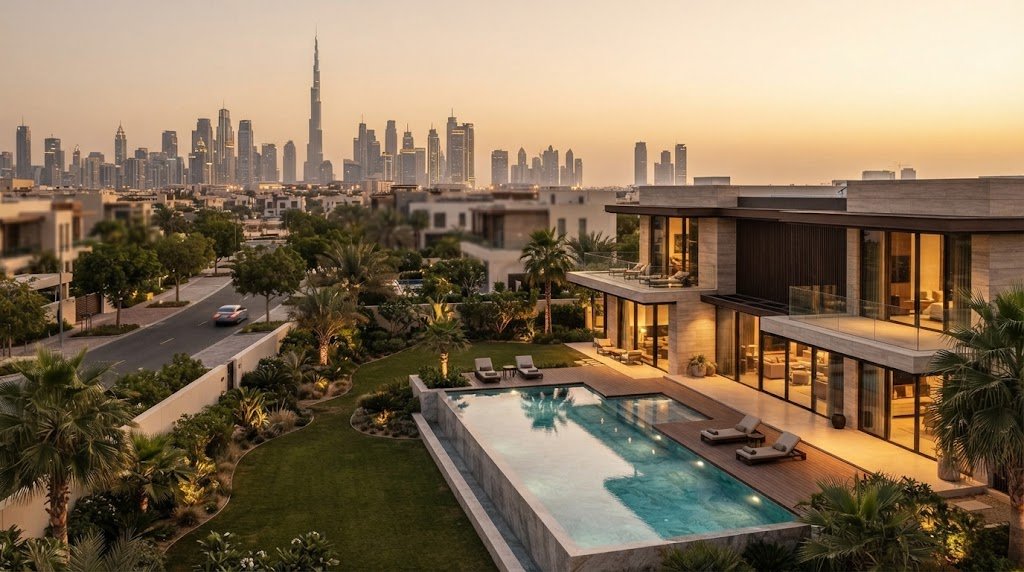
The 2026 correction was not uniform. Some communities fell sharply. Others rose. The difference came down to supply levels, end-user demand, and proximity to new infrastructure. Understanding this split matters more than the citywide average for any specific investment decision.
The following points show which Dubai communities were rising and falling by August 2026, based on verified ValuStrat data reported by Cavendish Maxwell and multiple market publications. Only figures confirmed across more than one reputable source are included here.
Apartment communities recording price falls by August 2026:
- Burj Khalifa area: down 19%
- Jumeirah Beach Residence: down 15.1%
Apartment communities recording price rises by August 2026:
- Dubai Silicon Oasis: up 6%
- Dubai Sports City: up 5.4%
Villa communities recording price rises by August 2026:
- Jumeirah Islands: up 15%
- Emirates Hills: up 9.1%
The pattern across verified communities is consistent. Oversupplied, high-profile, investor-heavy addresses fell hardest. Communities with genuine end-user demand, good infrastructure connectivity, and limited new supply either held firm or continued rising. This is a market that is differentiating by community, not collapsing across the board.
Luxury Market Kept Running
While the mid-market softened, Dubai’s luxury segment kept setting records throughout 2026. Dubai recorded 296 home sales above US$ 10 million during H1 2026,withthetotalvalueofthosetransactionsreachingUS5.1 billion, up 14% year-on-year. That is not the behaviour of a market in structural decline.
The luxury segment also shows why the citywide average is misleading on its own. When Burj Khalifa apartments fall 19%, and Jumeirah Islands villas rise 15% in the same period, the average tells you something happened but not what or where.

Why Prices Fell: The Three Causes
The 2026 correction had three distinct causes working together. Each one contributed. None of them alone would have produced the same result. Understanding why prices fell is the most important thing for Australian investors deciding what to do next.
Cause One: Geopolitical Shock
The regional conflict that began on 28 February 2026 hit buyer sentiment immediately. International buyers paused. Developers slowed launches. Transactions dropped. Physical prices fell 4 to 7% from their February peak within weeks.
The sentiment damage was real even though Dubai property itself was not directly affected. Global investors retreated to familiar markets while the conflict developed. Australian buyers, many of whom are newer to the Dubai market and more cautious than Gulf-based buyers, pulled back sharply in Q1.
Cause Two: Supply Pipeline
Around 131,000 new residential units were scheduled for delivery across 2026, the highest handover volume in Dubai’s history. By H1 2026, approximately 24,800 had already been delivered. That added significant choice for buyers and tenants at exactly the moment demand was softening because of the conflict.
More supply entering a nervous market amplifies price pressure. Both forces pulled in the same direction at the same time through Q1 and Q2.
Cause Three: Post-Boom Normalisation
Dubai’s market had delivered exceptional growth from 2020 through 2025. AED 917 billion in total property sales was recorded in 2025 alone.
The table below shows the three causes and their impact period.
| Cause | Start Point | Impact on Prices | Recovery Signal |
| Geopolitical conflict | 28 February 2026 | Immediate 4 to 7% fall from peak | April to June 2026 |
| Record supply pipeline | H1 2026 handovers | Added downward pressure on rents and prices | Slows in H2 2026 |
| Post-boom normalisation | Whole of 2026 | Gradual moderation from 2025 highs | Ongoing stabilisation |
Markets that grow that fast for that long naturally enter a period of consolidation. The correction in 2026 was partly a normalisation of the 2020 to 2025 run rather than a signal of structural weakness.
Is This a Crash or a Correction
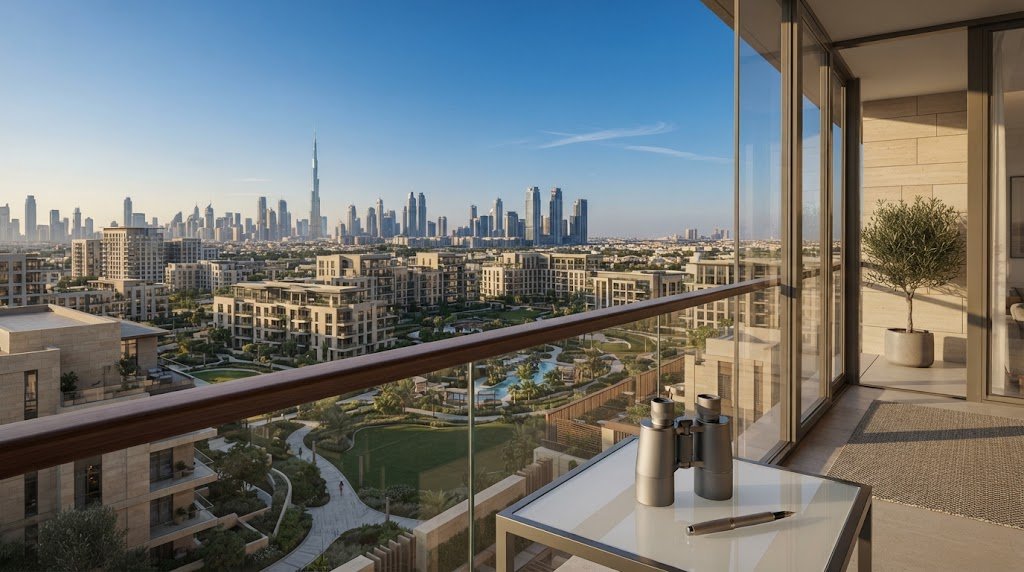
The critical question for Australian investors is whether what happened in 2026 is a structural breakdown or a temporary correction. The data supports the correction reading clearly.
The following points show why the 2026 price movement differs fundamentally from a crash.
- A crash involves structural economic failure, banking system stress, or mass forced selling. None of those are present in Dubai property in 2026.
- Q1 2026 DLD data confirmed AED 176.7 billion in property sales, up 23.4% year-on-year, even with the conflict starting mid-quarter. Buyers kept transacting.
- Average villa prices sat around AED 13.6 million and apartments around AED 1.85 million in early 2026. Even after the dip, values were nowhere near distressed levels.
- Dubai’s fundamental demand drivers remain intact: population growth past 4 million residents, UAE GDP growth projected at 5.6% for 2026 by the Central Bank, and rental yields averaging 6.34% as of August 2026, competitive against any major global city.
- The UAE government has strong incentives to maintain market stability. Property accounts for approximately 15% of Dubai’s GDP.
By September 2026, the market had stabilised. Prices were broadly flat month-on-month. The luxury segment was setting transaction value records. And analysts were describing 2026 as a transition to a more mature, selective market rather than a market in distress.
For Australian investors who own Dubai property already, the 2026 correction is a normal cycle event in a market that grew exceptionally fast. For those still deciding, the correction has created entry point opportunities in communities that held their fundamentals but saw prices soften for sentiment reasons rather than structural ones.
Our existing guides on which areas have historically performed best and what risks to watch are worth reading alongside this data.
What This Means for Australian Investors
Australian buyers face a specific set of considerations coming out of 2026 that differ from investors based in the Gulf or Europe.
The following points cover what the 2026 price data means specifically for buyers planning a Dubai purchase from Australia.
- Entry point improved: Communities that fell on sentiment rather than fundamentals now offer lower entry prices than early 2026. Dubai Silicon Oasis and Dubai Sports City both rose through the correction. JBR and Burj Khalifa fell significantly. The right community matters more than the citywide average.
- Rental yields held: Average rental yields remained at 6.34% in August 2026 despite the price correction. That is still well above Australian domestic investment property returns.
- Off-plan still dominant: Off-plan accounted for 75% of Q2 2026 transactions even at the low point. Developers kept selling, and buyers kept buying. Payment plans remain available and interest-free.
- AUD position improved: With Dubai property prices softer than early 2026 and the AUD trading at current levels, the effective cost of a Dubai purchase in Australian dollars is lower than it was at the market peak.
- Golden Visa unaffected: The AED 2 million threshold for the 10-year Golden Visa is unchanged. Price softening in the AED 1.5 to 2 million range means more buyers now qualify for the visa on a tighter budget than at the 2025 to early 2026 peak.
If you are still working through whether Dubai property investment makes sense for your situation, our guide on whether Dubai investment property is right for Australians covers the full case alongside the risks.
And for buyers looking at off-plan specifically through this period, our breakdown of off-plan properties in Dubai explains how the escrow and payment plan structure works through a softening market.
The End of 2026 Is Not the End of the Story
Dubai property market in 2026 went through its first correction in five years and came out the other side. Prices softened, transactions slowed, and some communities fell sharply. But the fundamentals that make Dubai worth buying into — zero property tax, strong yields, freehold ownership, and a government committed to market stability — never changed.
Bright Realty International works with Australian investors through every stage of a Dubai property decision, including navigating a market that is correcting and identifying which communities still make sense at current prices.
Contact Bright Realty International to discuss what the end-of-2026 market means for your specific situation.
Frequently Asked Questions
Are Dubai property prices falling in 2026?
Yes, but in a measured way. Cavendish Maxwell confirmed average residential prices at AED 1,636 per square foot in August 2026, down 1.7% year-on-year. This was the first annual decline since February 2021, triggered by a regional geopolitical conflict that began on 28 February 2026, combined with a record supply pipeline of 131,000 new homes scheduled for 2026.
Is Dubai property a good investment in 2026 after the price fall?
The fundamentals remain intact. Rental yields averaged 6.34% in August 2026, the luxury segment set transaction value records throughout the year, and Q1 2026 DLD data confirmed AED 176.7 billion in sales even with the conflict mid-quarter. The correction created entry opportunities in communities with strong fundamentals but softened sentiment prices.
Which Dubai property areas have fallen the most in 2026?
The sharpest verified falls hit the most-watched apartment addresses: Burj Khalifa area fell 19%, and Jumeirah Beach Residence fell 15.1% by August 2026, according to ValuStrat data reported across multiple market publications. These were the two community-level figures confirmed by more than one reputable named source.
Which Dubai property areas are still rising in 2026?
Dubai Silicon Oasis rose 6%, and Dubai Sports City rose 5.4% in the apartment segment, while in the villa segment Jumeirah Islands rose 15% and Emirates Hills rose 9.1%. These are communities with genuine end-user demand, good connectivity, and limited new supply, all figures confirmed across multiple reputable named sources.
How does the 2026 correction compare to previous Dubai property crashes?
It is the shallowest and shortest correction in Dubai’s modern property history. Physical prices fell 4 to 7% from the February 2026 peak, not the 30 to 40% that social media predicted. The market began recovering from April 2026. Previous corrections, including the 2008 to 2009 crash, were deeper, lasted longer, and were driven by banking system stress rather than sentiment.
Should Australian investors buy Dubai property now at the end of 2026?
The entry point at the end of 2026 is better than the February peak. Prices have stabilised, yields remain competitive, off-plan payment plans are still available interest-free, and the Golden Visa threshold of AED 2 million is now accessible at lower price points than at the peak. The answer depends on community selection and individual financial position, not on the market direction alone.