





Quick Answer
- Law No. 8 of 2007 mandates escrow.
- Funds go to a DLD-approved bank.
- The developer cannot access money freely.
- RERA orders refunds if the project is cancelled.
- Verify any project on the Dubai REST app.
Buying off-plan property in Dubai means paying for something not yet built. That makes most overseas investors nervous. Dubai solved this problem with one of the strictest escrow frameworks in the world.
What is the escrow account protection for off-plan buyers in Dubai, and how does it actually work? Under Law No. 8 of 2007, every payment you make goes into a dedicated, project-specific escrow account held by a DLD-approved bank, not to the developer. The developer cannot touch your money until an independent engineer certifies real construction progress.
This guide covers exactly how the law works, what protects your money at every stage, what happens if a developer defaults, and how Australian buyers can verify any project’s escrow status before transferring a single dirham.
What the Escrow Law Says
Law No. 8 of 2007 is the legal foundation of every off-plan property purchase in Dubai. It was introduced after the 2008 financial crisis exposed the risks of unregulated off-plan sales. Before this law, developers could use buyer funds freely. After it, they cannot.
The law governs guarantee accounts for real estate development in Dubai. It applies to every off-plan project registered with RERA. No exceptions exist for any developer, regardless of size or reputation.
What Law No. 8 of 2007 Requires
The following obligations apply to every RERA-registered developer under Law No. 8 of 2007.
- Developers must open a dedicated escrow account before selling a single unit.
- Each project must have its own separate escrow account, ring-fenced from the developer’s other projects and business operations.
- Only DLD-licensed banks can act as escrow agents for real estate projects in Dubai.
- The developer must obtain written DLD approval before advertising or accepting payments for any off-plan project.
- All buyer payments, from the booking deposit through to the final construction instalment, must be deposited into the project’s escrow account, not the developer’s operating account.
- Funds can only be released to the developer against verified construction milestones, certified by an independent RERA-approved engineer.
- Under Article 9 of Law No. 8 of 2007, escrow funds cannot be seized by the developer’s creditors even if the developer faces financial difficulty elsewhere in their business.
The table below shows how the escrow structure works compared to unregulated markets.
| Feature | Dubai Escrow (Law No. 8 of 2007) | Unregulated Market |
| Where buyer funds go | DLD-approved bank escrow account | Developer’s operating account |
| Developer access to funds | Only after verified construction milestones | Immediately on receipt |
| Protection from developer creditors | Yes, funds ring-fenced under Article 9 | No protection |
| Independent oversight | RERA-approved engineer and RERA itself | None |
| Buyer refund if project cancelled | Yes, mandated under the law | No guarantee |
This structure is fundamentally different from most international off-plan markets. The buyer’s money does not belong to the developer. It belongs to the project, held in trust by a regulated bank until construction earns its release.

How the Escrow Process Works in Practice
Understanding the legal framework is one thing. Knowing how it plays out from the day you pay your deposit is what actually matters for overseas buyers.
The following steps describe exactly how your money moves through the escrow system from reservation to handover.
- Booking deposit: Your initial deposit goes directly into the project’s escrow account at the DLD-approved bank. It does not touch the developer’s accounts.
- Instalment payments: Every subsequent payment follows the same route. Each goes into the escrow account, not to the developer.
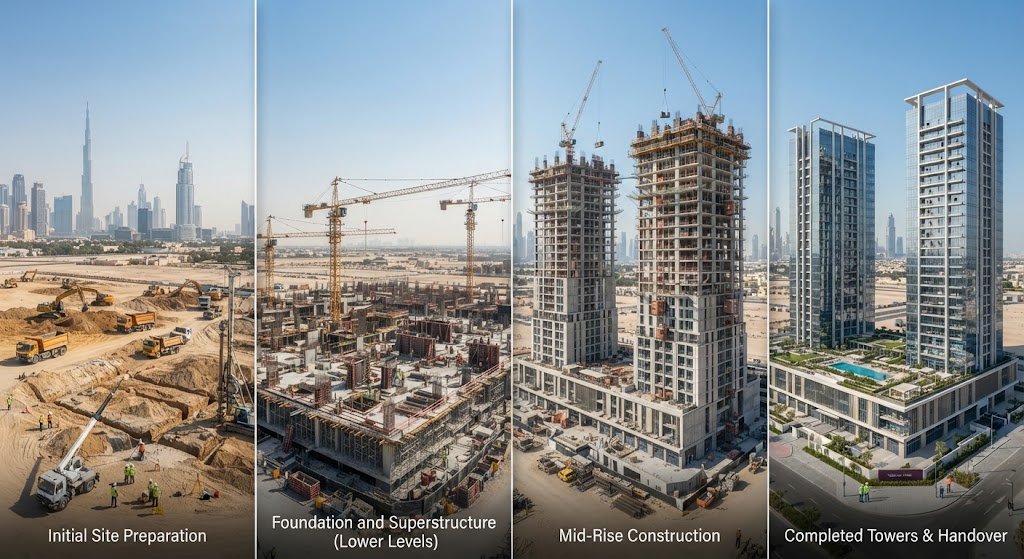
- Construction milestone reached: The developer completes a certified stage of construction, for example, foundation, structure, or external finishes.
- Independent engineer inspection: A RERA-approved independent engineer inspects the site and verifies that the milestone has genuinely been completed to the required standard.
- RERA approval: RERA reviews the engineer’s report and approves the fund release.
- Escrow release to developer: Only after RERA approval does the escrow bank release the corresponding portion of funds to the developer. Not before.
- 5% retention after handover: RERA retains 5% of the escrow account for 12 months after units are registered to buyers. This acts as a financial guarantee against post-handover defects, independent of the developer’s willingness to fix them.
This process means your payments literally cannot outpace real construction. The physical building has to exist before your money moves toward the developer.
What Happens If a Developer Defaults
Project failure in Dubai is rare since the escrow framework was introduced. Between 2019 and 2024, fewer than 2% of RERA-registered projects faced cancellation, according to DLD data cited in multiple market analyses. But the law covers what happens if it does occur.
RERA has three intervention options under Law No. 8 of 2007.
- Transfer to another developer: RERA can mandate that a new approved developer takes over the project. The escrow funds follow the transfer to the new developer. Construction continues.
- Full buyer refund: If RERA issues a final cancellation decision, the developer must return all amounts received from buyers. This obligation is set out in Law No. 8 of 2007 and Dubai Law No. 13 of 2008, as amended by Law No. 19 of 2020, which was reported by Khaleej Times and confirmed by Gulf News coverage of Dubai’s tightened off-plan rules.
- Extended construction timeline: If the project is fundamentally viable but delayed, RERA can extend the construction timeline with revised milestones, allowing the developer more time to deliver.
Recovery in worst-case scenarios typically takes 12 to 36 months from the point of RERA’s cancellation decision.
The table below summarises what happens to buyer payments at different stages of completion if RERA cancels a project.
| Construction Completion | Developer Obligation to Buyer |
| Project not started | Full refund of all payments made |
| Less than 60% complete | Developer may retain up to 25% of contract value, refund remainder within 1 year |
| 60% to 80% complete | Developer may rescind contract, must return all amounts paid |
| Above 80% complete | Developer may retain up to 40% if buyer defaults; if developer cancels, full refund applies |
These thresholds are set under Dubai Law No. 13 of 2008 as amended by Law No. 19 of 2020, as reported by Khaleej Times. They give buyers a clear legal framework for what they can expect to recover at each stage.
How to Verify a Project’s Escrow Status
Before transferring any funds for an off-plan purchase in Dubai, buyers can verify the escrow status of any RERA-registered project themselves. This takes less than 10 minutes and confirms the project is legitimate before any money moves.
The following points cover exactly how to verify a project before paying.
- Dubai REST app: Available on iOS and Android. Search by project name or RERA registration number. The app shows the live escrow account status, the name of the DLD-approved escrow bank, and the current construction completion percentage.
- RERA registration number: Every legitimate off-plan project has a RERA registration number. If a developer or agent cannot provide this number, the project is not registered with RERA and is not covered by the escrow law.
- DLD-approved escrow bank: Confirm the escrow bank is on the DLD’s list of approved escrow agents. Payments to any other account are not protected.
- Oqood registration: After signing the SPA, your purchase must be registered in the Oqood system, the DLD’s off-plan property registry. Oqood registration confirms your legal interest in the property before it is built and prevents the same unit from being sold twice.
- RERA developer registration: Confirm the developer holds a current RERA licence. RERA can cancel a project’s registration if construction fails to commence within six months of registration.
Never transfer funds to any account other than the project’s registered escrow account. A developer asking for payment to a personal account, a company operating account, or any account not matching the RERA-registered escrow details is a serious red flag.
What Escrow Does Not Cover
The escrow framework is strong, but buyers should understand what sits outside its protection.
The following points describe the limits of escrow protection under Law No. 8 of 2007.
- Service charges after handover: Once the title deed is issued and you take ownership, ongoing service charges are your responsibility. Escrow covers the construction period only.
- Construction delays without cancellation: If a project is delayed but RERA does not cancel it, escrow does not automatically trigger a refund. Buyers in a delayed project must go through RERA’s dispute resolution process.
- Buyer default: If you miss instalment payments, the developer can notify the DLD and issue a 30-day notice to remedy. If the default persists, the developer can cancel the contract and retain a portion of what you have already paid, depending on construction completion at that point.
- Market value changes: Escrow protects your principal payments. It does not guarantee the property will be worth what you paid for it at handover.
For a full picture of the risks alongside the protections in Dubai off-plan buying, our guide to the risks of buying property in Dubai covers both sides in detail. And for understanding how the DLD fees you pay at the point of handover fit into the total cost picture.
Practical Checklist Before Paying Any Off-Plan Deposit
Before transferring any funds for an off-plan purchase in Dubai, work through the following points. Every step is verifiable yourself before any money moves.
Completing each check removes the main risks in a Dubai off-plan purchase.
- Confirm the developer holds a current RERA licence.
- Confirm the project has a RERA registration number before signing anything.
- Verify the project on the Dubai REST app and check the escrow account is active and linked to a DLD-approved bank.
- Confirm the escrow bank name matches the RERA-registered escrow agent for the project.
- Sign the SPA only after confirming the project is registered in the Oqood system.
- Ensure all payments go to the registered escrow account, not any other account.
- Keep copies of all payment receipts showing the escrow account as the recipient.
- Check the project’s current construction completion percentage on the Dubai REST app before each instalment.
For Australian buyers completing this process from overseas, our guide on buying Dubai property remotely covers how each of these verification steps runs through a Power of Attorney arrangement without you needing to be in Dubai. If you want to understand how the full off-plan payment plan works alongside the escrow structure, our breakdown of off-plan properties in Dubai covers the payment mechanics step by step.
Invest in Dubai Off-Plan with Confidence
Dubai’s escrow framework is one of the most buyer-protective off-plan systems in the world. Law No. 8 of 2007, RERA oversight, independent engineer certification, and the 5% defects retention combine to ring-fence your capital from the deposit through to handover.
Bright Realty International works with Australian investors across every stage of a Dubai off-plan purchase, including verifying escrow status and developer registration before any funds are committed.
Contact Bright Realty International to confirm the escrow and RERA credentials of any project you are considering.

Frequently Asked Questions
What is the escrow account law for off-plan buyers in Dubai?
Law No. 8 of 2007 requires every Dubai off-plan developer to hold all buyer payments in a dedicated, project-specific escrow account at a DLD-approved bank. Funds can only be released to the developer after an independent RERA-approved engineer certifies that a verified construction milestone has been completed.
Can a Dubai developer access escrow funds freely?
No. Under Law No. 8 of 2007, the developer has no direct access to escrow funds. Each release requires independent engineer certification of a completed construction milestone and RERA approval. Under Article 9 of the same law, escrow funds cannot be seized by the developer’s creditors even if the developer faces financial difficulty.
What happens to my money if a Dubai off-plan project is cancelled?
If RERA issues a final cancellation decision, the developer must return all amounts received from buyers under Law No. 8 of 2007. RERA can also mandate that a new developer takes over the project with the escrow funds intact. Recovery in worst-case scenarios typically takes 12 to 36 months.
How do I verify a Dubai off-plan project’s escrow status?
Download the Dubai REST app on iOS or Android and search by the project’s RERA registration number. The app shows the live escrow account status, the DLD-approved escrow bank name, and the current construction completion percentage. Never transfer funds before confirming these details.
Does escrow protection apply to all Dubai off-plan projects?
Yes, provided the developer and project are registered with RERA. Any off-plan project not registered with RERA is not covered by the escrow law and should not be purchased until registration is confirmed. RERA registration is mandatory before a developer can legally advertise or sell off-plan units.
What is the 5% retention after handover?
RERA retains 5% of the escrow account balance for 12 months after units are registered to buyers. This acts as a financial guarantee against post-handover defects, covering the cost of fixing issues that appear in the first year of ownership, independent of the developer’s willingness to act.