



Australian property has let a lot of investors down quietly. The yields look acceptable on paper. Then tax, land charges, and strata fees arrive, and suddenly 3.2% becomes 1.6% net. That is not investing. That is wealth parking with extra steps.
Dubai investment property solves that problem structurally. Zero rental income tax. Yields between 7% and 12%. A regulatory framework that rivals anything in the Western world. But it is not right for every investor, and honesty matters.
This guide gives you the unfiltered assessment. You will learn what the numbers actually look like, which investor profiles Dubai suits best, what the real risks are, and how to decide whether this market belongs in your 2026 portfolio.
What Makes Dubai Investment Property Different

Most Australian investors approach Dubai with skepticism. That skepticism is healthy. It also disappears quickly once you understand the structural differences.
Dubai is not a speculative emerging market. It is a regulated, transparent real estate system backed by government infrastructure and global capital.
The Dubai Land Department recorded over AED 761 billion in property transactions during 2025, reflecting sustained demand from investors across more than 100 nationalities.
The Regulatory Foundation
Every Dubai investment property transaction is registered with the Dubai Land Department. Title deeds are government-issued and blockchain-verified. The Real Estate Regulatory Agency (RERA) licenses every developer and broker operating in the market.
For Australians accustomed to ASIC and state-based tenancy laws, this structure is reassuringly familiar. The system was purpose-built for international investors and functions accordingly.
Freehold Ownership Rights
Foreign nationals hold full freehold ownership in designated zones. That means a permanent title, no lease expiry, and complete freedom to sell, rent, or transfer the asset.
Popular freehold zones for Australian buyers include:
- Jumeirah Village Circle, for high yield at accessible entry prices
- Business Bay, for proximity to Dubai’s commercial core
- Dubai Marina, for strong short-term and long-term rental demand
- Dubai South, for early-stage capital growth near the airport expansion
The Numbers Australian Investors Actually Care About
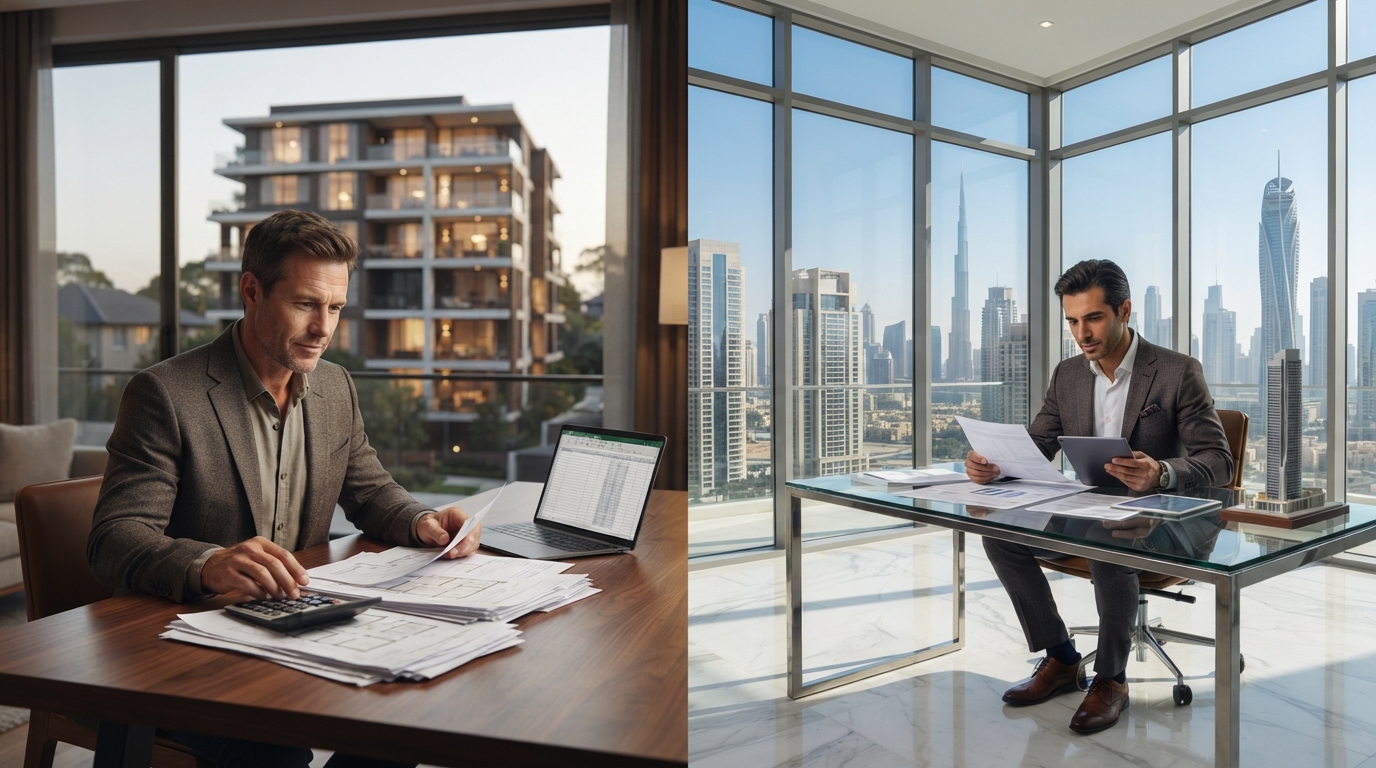
Experience teaches you one thing quickly. Investors do not buy stories. They buy numbers. So let us put the numbers side by side, honestly.
Yield Comparison
CoreLogic’s 2025 data shows Australian capital city gross rental yields averaging 3.2%. Sydney sits at 2.8%. Melbourne at 3.1%. Brisbane performs best domestically at approximately 4.1%.
Dubai investment property in well-selected communities delivers gross yields of 7% to 12%. Jumeirah Village Circle averages 9% to 11%. Business Bay sits between 7% and 9%. Even conservative estimates double the best Australian city figures.
The Tax Impact Nobody Talks About Enough
This is where the real wealth difference emerges over time. Consider this direct comparison:
Australian investment property at AUD 700,000, yielding 3.5% gross, generates AUD 24,500 annually. After income tax at 37% marginal rate, land tax, property management, and strata, the net return falls to approximately AUD 12,000. That is 1.7% net on your capital.
Dubai investment property at an equivalent AUD 300,000 entry, yielding 8.5%, generates AED 59,500 annually. Zero income tax applies. After management fees, you net above 7% consistently.
Additionally, the ATO requires Australian residents to declare overseas rental income. However, no foreign tax offsets need to be claimed on Dubai income since the UAE charges nothing. Your accountant confirms the net position, but the structural advantage is clear.
Who Does Dubai Investment Property Actually Suit

This is the honest part most guides skip entirely. Dubai is not the right move for every Australian investor. Knowing which profile fits saves you from a misaligned decision.
Investors Who Benefit Most
Dubai investment property delivers the strongest outcomes for Australians in specific situations:
- Investors priced out of Sydney and Melbourne are seeking quality assets under AUD 300,000
- Self-managed super fund trustees exploring diversification outside Australian residential property
- High-income earners in the 37% to 45% tax bracket, where Australian rental income is heavily eroded
- Investors seeking Golden Visa residency through property at the AED 2 million threshold
Investors Who Should Pause
Conversely, Dubai is less suitable for investors needing immediate liquidity within 12 months. It is also less suitable for those uncomfortable with currency conversion variability between AED and AUD. First-time investors without experienced guidance in place carry a higher execution risk.
The market rewards preparation. It punishes impulsiveness.
Real Risks, Assessed Honestly

After years in real estate, I have seen what happens when investors chase yield without understanding the risks attached to it. Dubai has real risks. They are manageable. They deserve direct discussion.
Developer and Delivery Risk
Not every developer in Dubai operates to the same standard. Smaller operators without documented completion histories carry meaningful risk for off-plan buyers. Construction delays of 6 to 12 months occur even with reputable developers.
The solution is straightforward. Stick to developers with verified RERA compliance records and multiple completed projects. Emaar, DAMAC, Binghatti, Imtiaz, Ellington, and Omniyat all maintain strong delivery track records. Your broker should provide completion data before you commit.
Currency Fluctuation
The AED is pegged to the USD at a fixed rate of 3.67, a peg that has held since 1997. However, AUD fluctuations against the USD create variability in your effective Australian dollar returns.
A strengthening AUD reduces your converted rental income. A weakening AUD amplifies it. Manage this with a minimum 3 to 5 year holding horizon. Short-term currency noise smooths considerably over longer periods.
Market Cycle Timing
Dubai’s property market corrected significantly between 2015 and 2019 before its strong recovery from 2021. Investors who purchased at the 2014 peak experienced several years of paper losses.
Understanding market positioning matters. Knight Frank’s 2025 Prime Global Cities Index notes that Dubai prime residential prices remain below their inflation-adjusted 2014 peaks in several communities, suggesting further appreciation of headroom. That context gives 2026 buyers a reasonable entry position.
What Dubai Investment Property Cost
Transparency on costs is non-negotiable. Here is exactly what Australian investors pay beyond the property price.
Upfront Transaction Costs
The total acquisition cost of Dubai investment property runs approximately 6% to 7% above the purchase price. That breaks down as follows:
- Dubai Land Department registration fee: 4% of property value
- Agency commission: 2% of property value
- Trustee and administrative fees: approximately AED 4,000 to AED 6,000
- Power of Attorney attestation from Australia: approximately AUD 800 to AUD 2,500
For context, New South Wales stamp duty on a AUD 700,000 property exceeds AUD 27,000 before any other costs. Dubai’s transaction cost structure is genuinely competitive internationally.
Ongoing Annual Costs
Service charges vary by community and building quality. Budget between AED 10 and AED 40 per square foot annually. Property management fees run 5% to 10% of annual rental income for full-service remote management.
There are no annual property taxes in Dubai. No land tax. No council rates. The ongoing cost structure is significantly simpler than the Australian residential investment.
How the Purchase Process Works for Australians
The process to acquire Dubai investment property from Australia is more straightforward than most investors expect. Here is the sequence from decision to title deed.
The Step-by-Step Process
Australians follow a clear, remote-friendly buying path:
- Engage a RERA-licensed broker and define your investment criteria clearly
- Review shortlisted projects with verified developer credentials and yield data
- Pay a reservation deposit (AED 5,000 to AED 50,000) to secure your unit
- Sign the Sales Purchase Agreement digitally or through Power of Attorney
- Complete payments per the agreed schedule into the RERA-regulated escrow account
- Receive the title deed upon completion via your registered representative
Most Australian investors never travel to Dubai during the purchase process. The Dubai REST app allows ownership verification at any stage.
Payment Plans That Favour Australian Buyers
Off-plan developer payment plans change the capital equation dramatically. Most projects require 10% at booking, staged milestone payments during construction, and a final amount at handover.
Critically, none of these installments carries interest. You pay the agreed price in structured stages with zero financing cost. Some developers extend payments 2 to 3 years post-handover, allowing rental income to fund your remaining obligations.
Dubai vs Australian Property: The Side-by-Side Reality
This comparison reflects what Australian investors are experiencing in both markets right now, not theoretical projections.
Entry Price and Accessibility
A quality one-bedroom apartment in inner Sydney costs AUD 750,000 to AUD 950,000. An equivalent unit in Dubai’s Business Bay costs AUD 180,000 to AUD 280,000.
That price gap allows Australian investors to hold Dubai investment property across multiple communities for the cost of a single local purchase.
Portfolio Role
Australian property typically anchors long-term capital growth strategies over 10 to 20 year horizons. Dubai investment property serves a different function. It generates active income from year one, builds medium-term appreciation, and offers flexible exit options in a highly liquid international market.
The two markets complement each other well. Many experienced Australian investors hold both, using Dubai income to offset Australian holding costs during low-yield periods.
Make Your Assessment With Clarity
Dubai investment property is not right for every Australian. However, for yield-focused investors, high-income earners eroded by Australian tax, and buyers priced out of local capital city markets, it presents a structurally superior alternative.
The numbers support the case. The regulatory framework supports the case. The entry prices support the case. What determines success is preparation, the right guidance, and a clear investment thesis before you commit.
Bright Realty International connects Australian investors with 100-plus curated Dubai investment property opportunities from verified developers. Our team understands both markets and coordinates every step of the process from Australia to the title deed.
Schedule your consultation at Bright Realty International
Frequently Asked Questions
Below are the one of the most frequently asked questions about s Dubai Investment Property Right for Australians in 2026?
Is Dubai investment property genuinely safe for Australians?
Yes, within a structured approach. The Dubai Land Department’s regulatory framework, RERA escrow protections, and blockchain-backed title registry create one of the most transparent property systems globally. Choosing verified developers and licensed brokers removes the majority of execution risk.
What rental yields can Australians realistically expect?
Well-selected Dubai investment property delivers gross yields between 7% and 12%, depending on community and unit type. Jumeirah Village Circle consistently achieves 9% to 11%. These yields apply before any tax deduction, since Dubai charges zero rental income tax.
Can Australians buy Dubai property through their SMSF?
SMSF property investment in overseas markets requires specific compliance with ATO regulations and trust deed provisions. Speak with an SMSF-specialist accountant before proceeding. Some structures permit overseas property within an SMSF. Others do not. Professional advice is essential before committing.
How does the escrow system protect my deposit?
RERA requires all off-plan developers to hold buyer funds in a dedicated, regulated escrow account. Independent engineers verify construction milestones before any funds are released to the developer. Your capital remains protected throughout the entire build period.
What is the minimum budget to start with a Dubai investment property?
Entry-level apartments in communities like JVC and Dubai South start from approximately AED 500,000 (around AUD 200,000). Developer payment plans reduce your upfront commitment to as little as 10% of that amount, making the initial capital requirement closer to AUD 20,000 to AUD 30,000 at booking.