





Quick Answer
- Dubai strata laws under Law No. 6 of 2019 make service charges legally mandatory for all owners of jointly owned property.
- Charges are calculated per square foot of your unit against a RERA-approved annual budget.
- Typical rates run from AED 3 per sq ft for villa communities to over AED 28 for premium towers.
- RERA must approve every service charge budget before a management company can invoice owners.
- Unpaid charges create a lien on your property, blocking any future sale until the debt is cleared.
Every Dubai property owner gets the annual service charge invoice and wonders if it is fair. You may be paying AED 18,000 or more on a single apartment, yet the lobby still needs work, and the lift keeps breaking. That gap between what owners pay and what they actually receive is one of the most common complaints in Dubai’s property market.
Dubai strata laws under Law No. 6 of 2019 exist precisely to close that gap. They require transparent budgets, independent audits, and RERA approval before any charge reaches you. Understanding how the system works gives you real leverage to question invoices, join the owners committee, and protect your investment from unjustified increases.
This guide covers how Dubai strata laws and service charges work, what the law says about owner obligations, what owners across different communities actually pay, and what to do when charges look wrong.
Understanding Dubai Strata Laws
Dubai strata laws govern jointly owned property, which is any building or development where individual units have separate titles but share common facilities. The legal foundation is Dubai Law No. 6 of 2019 on Ownership of Jointly Owned Real Property, which replaced Law No. 27 of 2007 and came into full effect in September 2019. It applies to all jointly owned developments across Dubai, including Special Development Zones and free zones.
Law No. 6 Basics
The law divides developments into three management categories. Major Projects are large mixed-use developments managed directly by the developer or an appointed company. Hotel Projects are handed to a RERA-approved hotel operator. All other residential and community developments fall under specialised management companies appointed and overseen by RERA. In every category, RERA is the ultimate regulator of every service charge invoice.
Understanding your management category matters because it determines who is accountable and how to escalate complaints. In a standard residential project, a RERA-appointed company handles day-to-day operations, and RERA can replace it if performance falls short. Knowing this before you buy gives you a clearer picture of the governance you are buying into.
Owners Committee Rights
Once at least 10 percent of units in a development are registered to private owners, RERA must establish an Owners Committee of up to nine members. Under Article 24 of Law No. 6 of 2019, the committee reviews the annual maintenance budget, verifies management company compliance, and escalates unresolved complaints to RERA within 14 days. It meets at least once every quarter.
Joining the Owners Committee is one of the most effective ways to influence how your money is spent. Members can request full financial statements, challenge line items in proposed budgets, and formally recommend that RERA replace underperforming management. If the committee is not active in your building, that is itself a red flag worth raising with RERA directly.
What the Law Protects
Law No. 6 of 2019 includes protections most owners do not know about. Under Article 27(a), a management company cannot collect any service charges without prior RERA approval of the budget. Under Article 30(c), collected funds are ring-fenced in a dedicated bank account and cannot be seized by the management company’s creditors.
Article 29 prohibits management companies from blocking a unit owner’s access to their property or shared facilities as a way of forcing payment. These protections exist, but owners need to know them to enforce them.

How Service Charges Work
Service charges are annual fees covering the operation and maintenance of common areas in your development. This includes lifts, lobbies, pools, gyms, security systems, building insurance, cleaning crews, and management company fees. Every owner pays a share proportional to their unit’s floor area.
RERA Approval Process
Under Article 27 of Law No. 6 of 2019, no management company can issue a service charge invoice until RERA has signed off on the annual budget. Before RERA approval, the budget must be certified by an independent audit firm recognised by RERA. Once approved, the budget is uploaded to the Mollak platform, RERA’s electronic system for jointly owned property launched by the Dubai Land Department in 2019.
Mollak handles approved budgets, invoices, escrow account monitoring, and owner statements. Every invoice you receive should trace back to an approved entry in Mollak. If a management company issues charges outside of Mollak, those charges are not legally enforceable.
Service Charge Index
The Dubai Land Department publishes the Service Charge Index, which shows the RERA-approved rate per square foot for every registered building in Dubai. You can check your building’s approved rate on the DLD website or through the Dubai REST app by entering your project name and year. Your annual charge is straightforward: multiply your unit’s floor area in square feet by the approved rate for your building.
How Service Charges Are Calculated
| Unit Size (sq ft) | Approved Rate (AED/sq ft/year) | Annual Charge (AED) | Quarterly Payment (AED) |
| 600 | 12 | 7,200 | 1,800 |
| 900 | 15 | 13,500 | 3,375 |
| 1,200 | 18 | 21,600 | 5,400 |
| 1,500 | 22 | 33,000 | 8,250 |
| 3,500 villa | 4 | 14,000 | 3,500 |
Rates are illustrative examples based on typical ranges from the DLD Service Charge Index. Always verify your specific building’s approved rate on the DLD portal.
What Service Charges Cover
Service charges are allocated across several categories in the approved annual budget. The typical split reported across RERA-regulated buildings is as follows.
- Building maintenance and repairs: 15 to 20 percent of the annual budget
- Utilities for common areas: 15 to 20 percent
- Cleaning and landscaping: 10 to 15 percent
- Management company fees: 10 to 15 percent
- Reserve (sinking) fund contribution: 10 to 15 percent
- Security: 8 to 12 percent
- Building insurance: 3 to 5 percent
District cooling, where applicable, may be included in the service charge or billed separately by a provider like Empower or Emicool. If district cooling is not in your service charge, expect a separate chilled water bill on top of your annual charge.

What Owners Actually Pay
Rates vary significantly by property type and location. The DLD Service Charge Index data confirms that apartment towers consistently carry higher per-square-foot rates than villa communities, reflecting the cost of shared infrastructure like lifts, central cooling, and facade maintenance at height.
Typical Service Charge Rates by Area (AED per sq ft per year)
| Area | Property Type | Typical Rate Range (AED/sq ft/year) |
| Emirates Hills | Villa | 1.5 to 2.0 |
| Arabian Ranches | Villa | 2.5 to 3.5 |
| Jumeirah Village Circle | Villa | 2.0 to 6.0 |
| Discovery Gardens | Apartment | 12 to 13 |
| Jumeirah Village Circle | Apartment | 13 to 22 |
| Jumeirah Lake Towers | Apartment | 13 to 17 |
| Business Bay | Apartment | 13 to 21 |
| Dubai Marina | Apartment | 14 to 28 |
| Downtown Dubai | Apartment | 20 to 30+ |
| Burj Khalifa | Apartment | 65 to 68 |
Indicative ranges based on DLD Service Charge Index approved data. Rates are reviewed annually. Verify your specific building’s rate through the DLD website or Dubai REST app.
Apartments vs. Villas
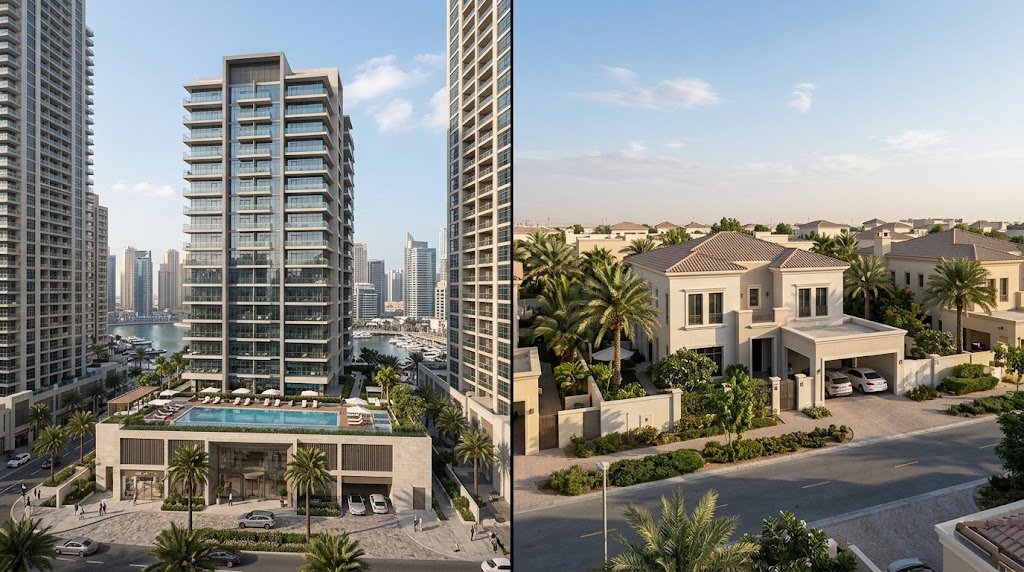
Villa communities share mainly roads, parks, entrance gates, and perimeter lighting. With fewer mechanised systems and lower security headcount, the per-square-foot cost is naturally much lower. A single lift in a residential tower can cost AED 80,000 or more per year to service, which explains why a Business Bay apartment might pay AED 18 per sq ft while an Arabian Ranches villa in the same period pays AED 3.
For overseas investors weighing apartments versus villa purchases, service charges should factor directly into yield calculations. Our guide to Dubai property investment strategy walks through how to model these costs alongside rental income before you commit.
Off-Plan and New Builds
Buyers purchasing off-plan properties in Dubai should know that service charges generally begin at handover, not before, unless a buyer caused the handover delay. Developers often provide indicative service charge figures during the sales process, but the actual RERA-approved rate is set after the first budget is submitted. Always check the DLD Service Charge Index for the most recent approved rate if the building has reached handover.
Service Charges as a Share of Gross Rent
| Area | Unit Size | Annual Rent (AED) | Annual Service Charge (AED) | Charge as % of Rent |
| JVC 1-bed | 690 sq ft | 67,000 | 8,300 | 12% |
| Business Bay 1-bed | 750 sq ft | 95,000 | 13,500 | 14% |
| Downtown studio | 450 sq ft | 80,000 | 12,600 | 16% |
| Dubai Marina 1-bed | 800 sq ft | 100,000 | 14,000 | 14% |
Rent figures are indicative market references. Service charges are estimated from DLD indicative range data. Use the DLD Service Charge Index for exact building figures.
The Reserve Fund Obligation
One charge that catches owners off guard is the reserve fund contribution, also called the sinking fund. This is a separate legal requirement under Article 30(e)(8) of Law No. 6 of 2019.
Why It Exists
The reserve fund covers the replacement of major common-area equipment when it reaches end of life. Lifts, fire suppression systems, water pumps, and pool infrastructure all have finite lifespans, and replacing them costs significantly more than maintaining them year to year.
Without a funded reserve, when major equipment fails, management companies issue a special levy requiring owners to pay a large lump sum immediately. The reserve fund prevents that by collecting smaller regular contributions each year as part of the approved annual budget.
How It Works
Under Article 30(e)(8), the reserve must be held in a separate dedicated bank account. Withdrawals require prior RERA approval except in genuine emergencies. Under Article 30(f), if the reserve fund runs short and emergency costs arise, the DLD can, with RERA approval, require owners to cover the shortfall directly.
When buying any Dubai property, ask specifically for the current reserve fund balance and compare it to the building’s age. A 15-year-old tower with a depleted reserve carries real risk. Our property management team includes reserve fund verification in every pre-purchase review for international clients.
Your Rights and Obligations
The law is clear about what owners owe and what they are owed in return. This balance matters especially for investors renting out a Dubai property from overseas who may be managing everything remotely.
What Owners Must Pay
Under Article 25(a) of Law No. 6 of 2019, every owner must pay their proportional share of the approved annual service charge budget. Under Article 28, owners cannot refuse to pay or claim set-off, even if they have a legitimate dispute with the management company. Withholding payment is not a lawful remedy under Dubai strata laws.
Critically, under Article 16(b), the owner remains liable for service charges even if the tenancy agreement requires the tenant to pay them. If a tenant defaults, the management company pursues the owner. Australian investors who structure leases to pass service charges to tenants need to monitor whether those charges are actually being paid.
The consequences of non-payment are serious. Under Article 32(a), the management company holds a lien over the property for the outstanding amount. The DLD will not issue a No Objection Certificate for a sale until all arrears are cleared. Under Article 32(c), in persistent cases of non-payment, the Rental Disputes Settlement Centre can order the property sold at public auction to recover the debt.
How to Dispute Unfair Charges
Owners have a structured process for challenging charges they believe are incorrect. The first step is a written complaint to the management company, which must respond within 14 days. If unresolved, the matter goes to the Owners Committee, which can escalate to RERA. Under Article 42 of Law No. 6 of 2019, the Rental Disputes Settlement Centre has exclusive jurisdiction over disputes under the law.
The Tayseer initiative, launched by RERA on 24 March 2025, provides eligible owners who are behind on service charges with payment plans of at least six months. Participating management companies agree not to pursue enforcement while a plan is active, offering a practical route for overseas owners dealing with arrears.
Dispute and Enforcement Process
| Stage | Action | Who Acts |
| Day 1 | Written complaint to management company | Owner |
| Within 14 days | Management company must respond | Management |
| If unresolved | Owners Committee escalates to RERA | Committee |
| RERA investigation | Accounts audited, compliance reviewed | RERA |
| After 30-day notice | Lien on unit, DLD blocks NOC | Management |
| Final step | Rental Disputes Centre may order auction | Court |
Checking Charges Before You Buy
The DLD Service Charge Index is one of the most useful tools for buyers doing due diligence. The DLD makes it publicly available and searchable by project name or title deed number. You can see whether a building’s approved rates have been rising, stable, or falling over multiple years, and compare them against similar buildings in the same area.
Pre-Purchase Due Diligence
Before exchanging contracts on any Dubai property, investors should get written confirmation that service charges are fully paid, and request a copy of the most recent RERA-approved budget. Ask for one to two years of Owners Committee meeting minutes to understand what issues exist. Ask specifically for the reserve fund balance relative to the building’s age.
For overseas investors buying in Dubai, these checks protect income from day one. A building with rising rates, persistent committee complaints, and a depleted reserve is a different investment from what it looks like at headline price.
Using the Dubai REST App
The Dubai REST app lets you check the Service Charge Index directly from your phone by entering the project name and selecting the year. If the rate shown on the app does not match what a management company is charging you, that discrepancy is grounds for a formal complaint to RERA.
Conclusion
Dubai’s strata laws under Law No. 6 of 2019 are more owner-friendly than most overseas investors realise. RERA approval is mandatory for every charge, budgets are independently audited, funds are ring-fenced, and owners have clear formal routes to challenge anything that looks wrong. Rates across Dubai run from under AED 2 per sq ft in established villa communities to over AED 65 in luxury towers, and understanding exactly where your building sits before you buy protects your returns from the start.
If you want a clear picture of what a specific Dubai property should be costing you in service charges, the team at Bright Realty International walks Australian investors through every figure before contracts are signed.
Contact us today to get a full breakdown of real annual costs on the property you are considering.
Frequently Asked Questions
Can my tenant pay service charges on my behalf?
Tenants can be contractually required to pay service charges under a lease. However, under Article 16(b) of Dubai Law No. 6 of 2019, the owner remains legally liable to the management company if the tenant fails to pay. Always monitor whether service charges are actually being paid on time, even if the lease passes that obligation to your tenant.
What happens if I refuse to pay service charges in Dubai?
Refusing to pay is not permitted under Article 28 of Law No. 6 of 2019. The management company records a lien against your property, the DLD blocks the No Objection Certificate needed to sell, and in serious cases the Rental Disputes Settlement Centre can order a public auction of the property to recover the outstanding debt.
How do I check if my service charges have been RERA-approved?
Every approved service charge budget is registered on the Mollak platform. You can verify your building’s approved rate through the DLD Service Charge Index on the Dubai Land Department website or through the Dubai REST app. If your management company is invoicing amounts not in the Mollak system, those charges are not legally enforceable.
Are service charges in Dubai subject to VAT?
Yes. Building maintenance and jointly owned property management services are generally subject to UAE VAT at 5 percent. Your annual invoice should itemise the VAT component separately. If VAT is being applied to exempt items, raise this in writing with the management company and escalate to RERA if unresolved.
Can service charges in Dubai increase every year?
Charges can change annually, but only with a new RERA-approved budget submitted through Mollak. Management companies cannot raise charges unilaterally. Every increase must be supported by the certified annual budget, independently audited and approved by RERA, before it can appear on any invoice.